
UAD Reinforce Dean Leadership for Building the University Global Reputation
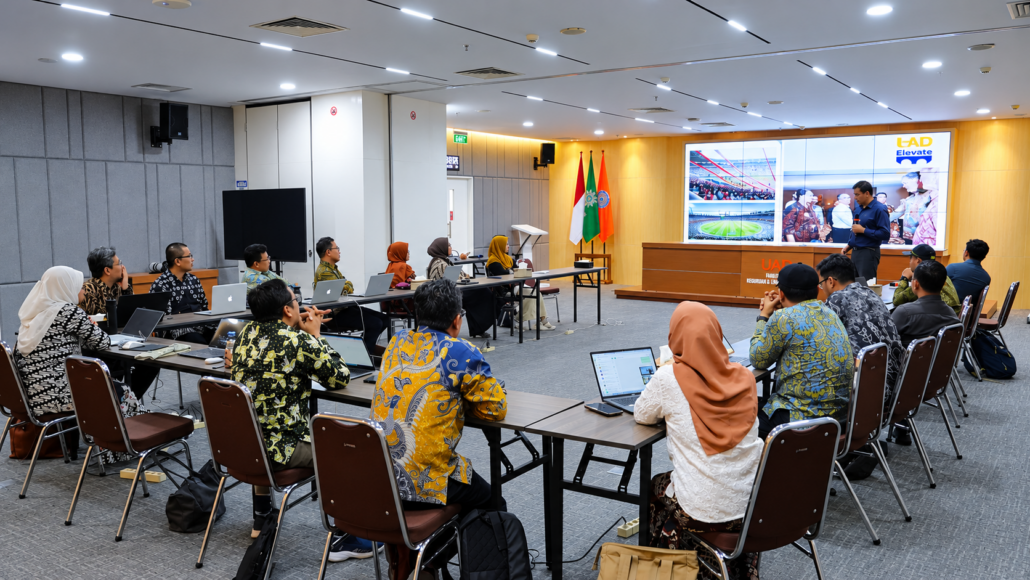
Universitas Ahmad Dahlan (UAD) held a Leadership Retreat for Deans under the theme “Higher Education Leadership: From Local Impact to Global Reputation” on Wednesday, September 23, 2026. The event provided a platform for reflection and capacity building for deans as they navigate the evolving higher education landscape and seek to enhance the university’s global reputation.
Prof. Hamish Bennett Coates, Ph.D., from Tsinghua University, China, served as the keynote speaker in a session titled “Higher Education Leadership: From Local Impact to Global Reputation.” In his presentation, Hamish emphasized that higher education institutions must not only deliver strong academic quality but also effectively communicate their strengths and impact to the wider community.
“Universities must have quality and also be able to ‘sell’ that quality,” Hamish remarked.
To illustrate the importance of visibility, Hamish compared universities to restaurants. He explained that even a restaurant serving high-quality food would struggle to attract customers if people did not know it existed. The same applies to universities that possess distinctive strengths but have yet to communicate their quality effectively to the public.
“If the food is delicious but nobody knows about the restaurant, customers will not come,” he explained.
Hamish stressed that strengthening competitiveness and institutional reputation cannot rely on promotion alone. Universities must demonstrate tangible impact through effective leadership, human resource and community development, scholarly contributions, and graduates who make meaningful contributions to society. These efforts must be accompanied by effective communication so that a university’s strengths can gain wider recognition, including at the international level.
He also highlighted the visibility of Indonesian higher education in the global landscape. According to Hamish, Indonesia has considerable potential and strong higher education institutions, but their presence in international academic discourse still needs to be strengthened. He shared an experience in which several international academics were asked to name universities in Indonesia, yet some were unable to identify any.
“This is not merely a matter of quality, but also of international visibility and communication,” he stated.
In addition to visibility, Hamish emphasized the importance of universities having the courage to experiment and take calculated risks to drive innovation. He cautioned that quality assurance should not make institutions so focused on regulatory compliance that they hinder the emergence of new ideas. Universities need to create room to test new approaches, learn from experience, and develop innovation continuously.
Meanwhile, UAD Vice Rector for Human Resources, Dr. Norma Sari, S.H., M.Hum., stated that the event provided an important opportunity for UAD to evaluate its achievements and formulate its future development priorities.
Through the Leadership Retreat for Deans, UAD encouraged deans not only to reflect on what had been accomplished but also to identify opportunities and strategic steps needed to improve the university’s quality and competitiveness.
The event was designed as an interactive workshop combining expert presentations, guided reflection, discussions, and brainstorming sessions. Through these activities, each faculty was expected to identify its strengths and potential and translate them into development strategies that deliver tangible impact.
These strategic initiatives include strengthening international partnerships, enhancing academic readiness, developing graduates, and building UAD’s global reputation. Ultimately, faculty leadership is expected to play a more effective role in connecting the university’s quality and tangible contributions with greater recognition at the international level.
